pays
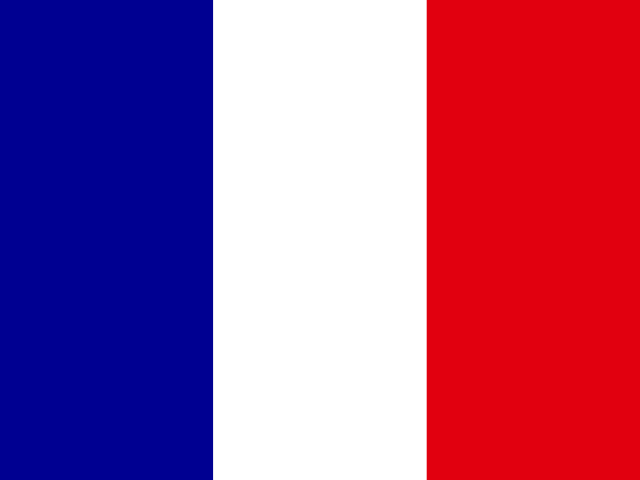
La France est un beau pays.
France is a beautiful country.
A nation with its own government, occupying a particular territory.
Le Canada est un pays bilingue.
Canada is a bilingual country.
L'Italie est connue pour sa cuisine.
Italy is known for its cuisine.
Used in both formal and informal contexts. Often paired with adjectives describing nationality or characteristics.
Native land; the place where one was born or raised.
Il a quitté son pays pour chercher une vie meilleure.
He left his homeland to seek a better life.
Common in poetic or emotional contexts.
Collocations
Synonyms
Pro Tip
Gender and Articles
'Pays' is always masculine in French ('le pays'). When referring to a specific country, use the definite article (e.g., 'le Japon', 'les États-Unis').
Gold Rule
Common Collocations
Remember common collocations like 'pays natal' (native country), 'pays d'origine' (country of origin), and 'pays développé' (developed country) to sound more natural.
Word Origin
From Old French 'païs', from Latin 'pagus' (district, region), ultimately from Proto-Indo-European '*pag-' (to fasten, fix). Related to 'pagan' and 'paysage' (landscape).
Usage Notes
In French, 'pays' can refer to a country or homeland. It is masculine ('le pays') and often used with adjectives describing nationality (e.g., 'pays voisin' = neighboring country). Avoid confusion with 'paysage' (landscape) or 'paysan' (peasant).