Looking up...
nation
/na.sjɔ̃/
nation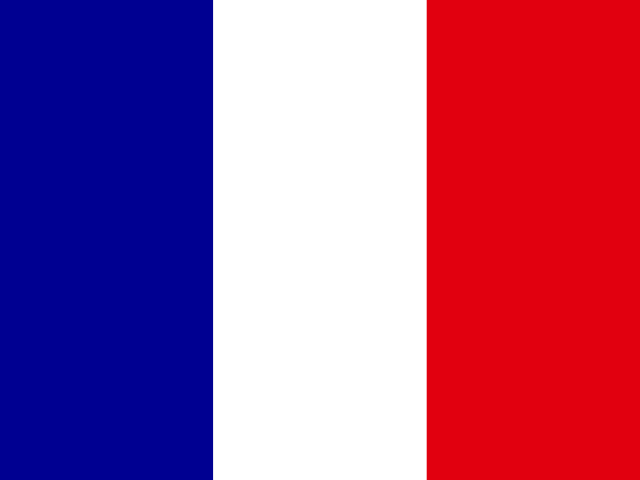
La nation française est fière de son histoire.
The French nation is proud of its history.
formal
A large group of people sharing a common identity, culture, history, or language, typically associated with a specific territory.
Les Nations Unies ont été créées pour promouvoir la paix mondiale.
The United Nations were created to promote world peace.
Often used in political, historical, or sociological contexts.
formal
A country considered as a whole, especially in terms of its people, institutions, and sovereignty.
La nation a voté pour un nouveau président.
The nation voted for a new president.
Emphasizes the collective identity of the citizens.
Collocations
la nation françaisethe French nationla nation entièrethe entire nationla fierté nationalenational pride
Antonyms
Pro Tip
Avoid confusion with 'peuple'
'Nation' refers to the entire population of a country with shared identity, while 'peuple' can refer to a specific group or social class within that nation. Example: 'Le peuple français' (the French people) vs. 'la nation française' (the French nation).
Gold Rule
Use 'nation' for formal contexts
Prefer 'nation' in political, historical, or institutional discussions. For casual contexts, 'pays' (country) or 'peuple' (people) may be more natural.
Word Origin
From Latin *natio* (birth, origin, race), derived from *nascor* (to be born). The term evolved in Old French as *nacion* (birth, race, people) and entered English via Old French in the 14th century.
Usage Notes
In French, 'nation' often implies a collective identity tied to a territory and shared values, while 'peuple' may emphasize the people as a social class. 'Nation' is more formal and is commonly used in political or institutional contexts.
Word Breakdown
nat-
birth, origin
root-ion
action or state
suffixDictionnaire Français-Anglais